About two weeks ago, while traveling around the internet, I found this:
Which was really weird and interesting. People started talking about it over on SomethingAwful and Unfiction picked it up.
After a brief discussion on QuarterToThree, a lot of people said, "I wish I had the time/energy/inclination to follow up on this, but I don't. I'd really love it if someone would just keep track of it for me in one thread so I could read about it and kind of, almost participate in an ARG."
Behold! I started the TIMM thread at QuarterToThree which I'm keeping updated. Yes, there are two wiki's, a sub-forum on UnFiction, and a thread on SomethingAwful, as well as various other places to keep up, but that Qt3 thread is mine. So there.
Also, the format there is a little better than here for keeping it up to date and readable, with comments from other posters. So I thought I'd link to it here, but over there is where I'm posting updates.
Showing posts with label ARG. Show all posts
Showing posts with label ARG. Show all posts
Thursday, December 11, 2008


Sunday, August 24, 2008
Boston Gameloop '08
Yesterday was the first ever Boston Gameloop UnConference which took 45 local developers, threw them into the MIT-Singapore Gambit Lab and expected them to talk about interesting things.
We did.
This is the brainchild of Darius Kazemi and Scott MacMillan who have been turning the Boston Post Mortem into a real developer community over the last year or so (and I'm probably showing that I have my head up my ass by not mentioning the other people on the BPM committee, sorry, other people). Darius asked us to write, post, or even just email our scanned notes to him and he would transcribe them.
When he asked that I made this:

That's Ralph, a little guy I've been drawing since I was eight. Yesterday, for some reason, he had a mullet. I was just trying to bring a little visualization to the proceedings. Oh, and yes, we learned the earth-shattering fact that a free open bar gets people to come to your event. There was no free open bar (isn't that redundant?) at Gameloop.
We arrived at the ungodly hour of 9am on a Saturday, and we milled about, as geeks will do. We were told to put up a topic that we wanted to talk about, or if we weren't sure there would be enough interest in our topic, but it up as a trial topic on a sheet on the board. We would put a hash mark on anything we were interested in. If a trial topic got enough has marks (no definition of "enough") then we could move it over to a card and schedule it.
After a bit, the board started looking like a schedule, and eventually it looked like this:

So here was my day, and I apologize if I don't get the titles quite right:

Afterwards, there was a brief announcements session and a promise that we would all do it again, but not for a year or so, and starting at 10am instead of 9am, maybe with healthier foods, and with t-shirts that weren't orange.

Then there was beer at CBC, with even more discussion. All in all it was a very tiring, very rewarding day.
We did.
This is the brainchild of Darius Kazemi and Scott MacMillan who have been turning the Boston Post Mortem into a real developer community over the last year or so (and I'm probably showing that I have my head up my ass by not mentioning the other people on the BPM committee, sorry, other people). Darius asked us to write, post, or even just email our scanned notes to him and he would transcribe them.
When he asked that I made this:

That's Ralph, a little guy I've been drawing since I was eight. Yesterday, for some reason, he had a mullet. I was just trying to bring a little visualization to the proceedings. Oh, and yes, we learned the earth-shattering fact that a free open bar gets people to come to your event. There was no free open bar (isn't that redundant?) at Gameloop.
We arrived at the ungodly hour of 9am on a Saturday, and we milled about, as geeks will do. We were told to put up a topic that we wanted to talk about, or if we weren't sure there would be enough interest in our topic, but it up as a trial topic on a sheet on the board. We would put a hash mark on anything we were interested in. If a trial topic got enough has marks (no definition of "enough") then we could move it over to a card and schedule it.
After a bit, the board started looking like a schedule, and eventually it looked like this:

So here was my day, and I apologize if I don't get the titles quite right:
- Interactive Actors that Express Emotion - was an actual talk prepared by Gerry Seidman from Actor Machine. He's working with Ken Perlin on a bunch of Maya plugins that will allow a model to be given a character, or a basic description which will allow the model to animate in line with the character. Basically you don't have to keyframe everything, behaviors are part of the model itself. Gerry showed a lot of demos from Ken Perlin's actors page. This would seem to enable very quick, procedurally generate crowds, as well as low-overhead projections for live performances. I'm going to ceep in contact with Gerry on this, as some of my projection work could benefit from this, as long as it would all work with importing models into Unreal.
- Boston Games Industry, What's Next? - Did you know our Post Mortem is the best attended and most frequent IGDA meeting in the world? Did you know Massachusetts has recently instituted tax benefits for the film industry, and at the last moment included the game industry in those benefits? Did you know the general perception in the games industry is that there are no developers in or around Boston? Yeah, that last one sucks. So what's next for the Boston games industry seemed to be two things:
- We need better PR to tell people that we exist. It occured to me this morning while reading Edge, that every month they spotlight a different city or region, get a roundtable of all the developers there, then do individual articles about the major developers in that area, yet I hadn't read one about Boston. Hmm... So basically we need a Local Game Industry Evangelist, which was when everyone looked at Darius.
- The other thing was to leverage our strengths, which seemed to be that we're a hotbed of academia with a number of very strong game development programs. The talk then turned to internships and entry-level hiring vs. experienced hiring. I outed myself as an academic (there were no academics allowed at this, though the MIT-Gambit lab seems perilously close to academia, and they were well represented) and talked about when to look for interns. It seems to me that game companies don't think summer starts until June, when all the WPI kids leave at the beginning of May. I asked them to start looking in March/April in order to actually get local kids into local companies.
- LUNCH! Pizza and soda. Not doing my waistline any favors.
- Board Games Workshop - in which we took familiar board games and discarded the rules and made new ones. We grabbed Scrabble and, after some farting around, Devin Griffiths (who said he wasn't a designer. "Feh," I say to you, "Feh.") came up with Scrabble Hold 'Em which put three common tiles in the middle of play and gives each player four tiles to make words with. The first player to finish gets 5 extra points, the player with the longest word gets 2 extra points. We were trying to make a very short game, and we were trying to eliminate the downtime in Scrabble where you're sitting there as the other person stares at their tiles. Even then, we wanted to solve another problem of Scrabble, that players don't interact, so we came up with Scrabble Stealing in which each player gets 7 tiles and starts to make words, but at any time another player can offer a tile and "steal" a random tile from you. Tiles already in complete words were "safe." When the first person uses up all their their tiles, the game is over, and you only get scored on tiles in words. This again kept it short, gave a "screw you" element to the game, and rewarded people for coming up with the first word they saw instead of staring at their tiles forever. This hour probably went by the fastest of the day.
- Low tech games (ARGs != Marketing) is the session I proposed. I wanted to talk about indie ARGs and bring game design sensibility into what seems to be a "webbie" industry. At ARG Fest O Con, it seemed odd to me that not one local game developer was present, in fact, even though it was announced at Post Mortem, most every game developer at GameLoop didn't know about it. I deal with the problems of getting players for our ARGs, because they're quick, they're free, and most people "like the idea but just don't have the time." I described the inverted pyramid -- hardcore at the tip doing most of the content, casuals in the middle watching the hardcore, cheering them on, but not really participating, and the lurkers who tune in, don't have time, and read about how it went when it's all over. This seems remarkably like a problem that MMO developers deal with. Do you make more content for the hardcore, or do you serve the casuals? One idea that came up for ARGs, was a very quick ARG (my class does 5 day ARGs) that you sell tickets to. That would monetize the ARG, localize the ARG, and everyone participating would know that the commitment was short. This really takes a page from LARPing and Murder Mystery Dinner Theatre. I'm going to think about this more. My one regret was that there were two other bitchin' sessions during mine, and I would've liked to go to both of them.
- Turning Licensed Properties into Games - This was a talk that Matt Weise and Geoff Long are prepping for Austin GDC, basically pointing out that licensed games only recreate a small subset of the activities portrayed in their source material, and that the barrier to using more is no longer technical, it's a lack of imagination. Unfortunately, when they asked me to name the last movie I had seen, I replied (truthfully!), "Shooter." It was not the best illustration of their point, but we moved on to Rudeboy, Almost Famous, and Death Note. They used conversions of James Bond properties to shooters as a good example, and then went one step further to point out a weird verb in the Bond lexicon -- "Use super senses." This is when Bond shoots exactly the right thing to cause a chain reaction that saves his bacon. In one of the Bond games, they translated this as "Bond sight" where bond can see targets that will cause unexpected things to happen and create "Bond moments." I'd like to see them extend this and not just handwave that verbs like seduce, investigate, and grow up are possible, but show us how they've already been done in other games. That would pretty much prove their thesis.
- Finally, OMG Jonathan Blow is teh Awesome! or Design and Narrative - This was Scott leading a roundtable that was interesting, but also somewhat maddening, because some of us were speaking different languages. There seemed a whole camp (led by Tynan and Scott) who saw emergent stories as the future, but admitted that the stories had to be interpreted (read, rewritten) by humans in order to become interesting. So AAR's of Starcraft become interesting because a human is interpreting what would be unintelligible if you just watched the game. Additionally, there are a whole host of games, all strategy titles, which have interesting events happen, that, when strung together become a narrative that was experienced by the player. Personally, I don't see AARs of strategy games as threatening the novel anytime soon. When the writer-types in the room (myself, and Devlin leading that charge) talk about game narrative, we still want a feeling of authorship on our part. Bioshock is pretty much the same story for everyone who plays it, and it has definite high points and lulls, which were designed by the writer and designers. Mostly I wanted to talk about Braid, but everyone in the room hadn't finished it, and that put a bit of a damper on that discussion. Again, Braid is being held up as what games are capable of as narrative, but everyone who plays it has more or less the same experience. Braid is authored, whereas King of Dragon Pass, and Dwarf Fortress are designed in such a way that interesting things might happen. And that's a big might. Most of the time, nothing interesting happens, but when something special does happen, that's the one instance the player remembers and recounts.

Afterwards, there was a brief announcements session and a promise that we would all do it again, but not for a year or so, and starting at 10am instead of 9am, maybe with healthier foods, and with t-shirts that weren't orange.

Then there was beer at CBC, with even more discussion. All in all it was a very tiring, very rewarding day.
Saturday, July 26, 2008
ARGFest-O-Con '08
Last weekend ARGFest-O-Con '08 took place at the Radisson Hotel in Boston. I heard about it through the IGDA ARG Sig mailing list, and, after checking out their site, figured it was just a bunch of ARG enthusiasts from Boston.
Except there were people there from all over the country, some of the biggest names in both commercial and independent ARGs, and the whole thing was sponsored by 42 Entertainment. This was the seventh annual ARGFest-O-Con, which began when Sean Stacey, the guy who runs unfiction.com decided to go visit Steve Peters in Vegas and posted on unfiction that people should join them for a beer. More people showed up than they bargained on.
Seven years later I blunder in, and was welcomed with open arms. These people are some of the coolest, nicest, most talkative people I've ever met. I didn't preregister, I don't have an account at unfiction, and I basically had no clue. Within 30 minutes of arriving I was talking to people I had never seen before about all sorts of things, including which games I've played and which I haven't. By the end of the cocktail party on Friday night, I had made a number of contacts, and, I think, a number of friends.
Also during the cocktail party an unkempt, drunk man stumbled in, warned us all about the invisible people, tried to punch an invisible person but only managed to spill his drink, then stumbled out again. The hotel staff looked nervous. The crowd applauded. One woman yelled, "He dropped some papers!" Everyone crowded around a picture of the New England School of Law which, coincidentally, is right across the street from the Radisson. A smaller group rushed off to investigate, but I returned to my newly bought beer.
Perhaps forty-five minutes later the same man, now showered and sheveled (is that a word?) sat down next to me and struck up a conversation. I bought him a drink, observed that I had recently seen him as a drunk paranoid schizophrenic, and he told me that some ARG puppetmasters had asked him to play the part. I found out that it was part of a larger, ongoing ARG (phew! at least I wouldn't have to go running off after every clue here at the con), and that the information gathered as part of his clues wouldn't pay off for another two or three weeks online.
When the investigators returned they had the same information I did, but they ran around some hot Boston streets to get it, whereas I had just bought a guy a drink. I guess there's more than one way to play an ARG.
Saturday was a full day of talks and panels, some great, some okay. In the middle of Steve Peters' talk (where he pointed out that all ARG heroines are studious looking, attractive brunettes), this guy walked in:

And only at an ARG conference would the audience begin taking pictures of his tatoos, looking for a possible clue. After all, we were going to have to solve a series of puzzles in order to find out where dinner was that night. I don't know if anything printed on him ever paid off, but I found dinner without referencing him. I think Steve was just trying to go against stereotype and used a visual aid to prove his point, but that's the problem of ARG's. What's a clue? What's a troll? Which are the red herrings and which will pay off?
There is also a real dichotomy between the commercial ARGs which are all for marketing something else (like Why So Serious, Vanishing Point, and Year Zero) and the independent ARGs (like Perplex City, World Without Oil, or Deus City). As evidenced by this blog, most people have only seen the big marketing pushes and don't even know about the independents making ARGs for ARGs sake.
And that's because no one has found a way to make people pay for the ARG experience besides using it as a marketing tool. Majestic failed. I suppose Perplex City at least broke even, but I hear Adrian Hon isn't going anywhere near Season 2 because Season 1 seriously exhausted him. Of course, Adrian is over at We Tell Stories, which seems a much less taxing take on mixed media (and it's sponsored by Penguin Books so it probably pays better).
Saturday evening kicked off with FestQuest, a chance to run around the streets of Boston (93 degrees at 6pm) solving puzzles. Our first puzzle:
 which the group solved in the lobby while I was in the bathroom. We had to find the sculpture of the Tortoise and the Hare, which is apparently in Copley Sq. (my wife told me afterwards). Now I've been around Boston, I can find an address, but ask me to find a particular sculpture? Nope.
In the end it didn't matter. We spent an hour and a half wandering around the common looking for the statue, then decided to try to solve the other puzzles. We skipped to location #5, which was 45 School St. (Old City Hall), and from the clues there, put it together that we were supposed to meet the group at Fanueil Hall.
We were the last to arrive. (sigh)
I ended up having dinner with a PR rep for the LA school district and two German viral marketers in the North End. I went crazy at the silent auction, and ended up getting the 42 Productions package, which included two NiN CD's, the I Love Bees ending DVD, a Vanishing Point t-shirt, and a bunch of stickers and buttons. I went in for the I Love Bees DVD, but really enjoyed the Year Zero NiN CD (I had already downloaded the Ghosts CD).
Great stuff, all in all. Next year, if the timing works out, I'll fly out to Portland, Oregon for ARGFest-O-Con '09.
Except there were people there from all over the country, some of the biggest names in both commercial and independent ARGs, and the whole thing was sponsored by 42 Entertainment. This was the seventh annual ARGFest-O-Con, which began when Sean Stacey, the guy who runs unfiction.com decided to go visit Steve Peters in Vegas and posted on unfiction that people should join them for a beer. More people showed up than they bargained on.
Seven years later I blunder in, and was welcomed with open arms. These people are some of the coolest, nicest, most talkative people I've ever met. I didn't preregister, I don't have an account at unfiction, and I basically had no clue. Within 30 minutes of arriving I was talking to people I had never seen before about all sorts of things, including which games I've played and which I haven't. By the end of the cocktail party on Friday night, I had made a number of contacts, and, I think, a number of friends.
Also during the cocktail party an unkempt, drunk man stumbled in, warned us all about the invisible people, tried to punch an invisible person but only managed to spill his drink, then stumbled out again. The hotel staff looked nervous. The crowd applauded. One woman yelled, "He dropped some papers!" Everyone crowded around a picture of the New England School of Law which, coincidentally, is right across the street from the Radisson. A smaller group rushed off to investigate, but I returned to my newly bought beer.
Perhaps forty-five minutes later the same man, now showered and sheveled (is that a word?) sat down next to me and struck up a conversation. I bought him a drink, observed that I had recently seen him as a drunk paranoid schizophrenic, and he told me that some ARG puppetmasters had asked him to play the part. I found out that it was part of a larger, ongoing ARG (phew! at least I wouldn't have to go running off after every clue here at the con), and that the information gathered as part of his clues wouldn't pay off for another two or three weeks online.
When the investigators returned they had the same information I did, but they ran around some hot Boston streets to get it, whereas I had just bought a guy a drink. I guess there's more than one way to play an ARG.
Saturday was a full day of talks and panels, some great, some okay. In the middle of Steve Peters' talk (where he pointed out that all ARG heroines are studious looking, attractive brunettes), this guy walked in:

And only at an ARG conference would the audience begin taking pictures of his tatoos, looking for a possible clue. After all, we were going to have to solve a series of puzzles in order to find out where dinner was that night. I don't know if anything printed on him ever paid off, but I found dinner without referencing him. I think Steve was just trying to go against stereotype and used a visual aid to prove his point, but that's the problem of ARG's. What's a clue? What's a troll? Which are the red herrings and which will pay off?
There is also a real dichotomy between the commercial ARGs which are all for marketing something else (like Why So Serious, Vanishing Point, and Year Zero) and the independent ARGs (like Perplex City, World Without Oil, or Deus City). As evidenced by this blog, most people have only seen the big marketing pushes and don't even know about the independents making ARGs for ARGs sake.
And that's because no one has found a way to make people pay for the ARG experience besides using it as a marketing tool. Majestic failed. I suppose Perplex City at least broke even, but I hear Adrian Hon isn't going anywhere near Season 2 because Season 1 seriously exhausted him. Of course, Adrian is over at We Tell Stories, which seems a much less taxing take on mixed media (and it's sponsored by Penguin Books so it probably pays better).
Saturday evening kicked off with FestQuest, a chance to run around the streets of Boston (93 degrees at 6pm) solving puzzles. Our first puzzle:
 which the group solved in the lobby while I was in the bathroom. We had to find the sculpture of the Tortoise and the Hare, which is apparently in Copley Sq. (my wife told me afterwards). Now I've been around Boston, I can find an address, but ask me to find a particular sculpture? Nope.
In the end it didn't matter. We spent an hour and a half wandering around the common looking for the statue, then decided to try to solve the other puzzles. We skipped to location #5, which was 45 School St. (Old City Hall), and from the clues there, put it together that we were supposed to meet the group at Fanueil Hall.
We were the last to arrive. (sigh)
I ended up having dinner with a PR rep for the LA school district and two German viral marketers in the North End. I went crazy at the silent auction, and ended up getting the 42 Productions package, which included two NiN CD's, the I Love Bees ending DVD, a Vanishing Point t-shirt, and a bunch of stickers and buttons. I went in for the I Love Bees DVD, but really enjoyed the Year Zero NiN CD (I had already downloaded the Ghosts CD).
Great stuff, all in all. Next year, if the timing works out, I'll fly out to Portland, Oregon for ARGFest-O-Con '09.
Wednesday, June 27, 2007
Missing
Okay, so it's been awhile. I've been busily powering through games, but forgetting to take screenshots. I finally got around to this semi-ARG, Missing, and powered through that. I'm trying to put together a project on making a permanent ARG, i.e. one that you can start at anytime and it will work. Most ARGs nowadays have a set runtime (the Halo 3 ARG just started up over at Society of the Ancients and the main Halo 3 website.)
But I'm writing about Missing. It's got a great premise: an investigative reporter and his girlfriend (who turns out to be more than a girlfriend) have gone missing. The web-based documentary film company he works for received a CD, which they at first dismissed as a prank, but have found new proof that it was sent by whoever has kidnapped the pair. It's full of puzzles and it's all encyphered, and instead of turning it over to the proper authorities, they're making it available to the public at large in the hopes that someone will be able to figure it all out. It's kind of like SETI-at-home of crime solving.
 It's all very creepy, and it's an old game-- four years old, in fact. It relies heavily on websites and even email in order to tell its story, so it's a good test of whether a persistent ARG can work.
It doesn't.
There are really three reasons for this, first, a sequel called Evidence: The Last Ritual has already come out (and I have it, and it's in my "to be played" pile). So, for instance, a very early puzzle tells me the answer I need to continue is at http://www.xeniph.com/ which forwards you to http://www.xineph.com/31504052414/ which is a nifty little puzzle. If you solve it (which I did), you will not get an answer that will allow you to progress on the CD. In fact, that puzzle occurs nowhere in Missing at all, so I can only theorize that it's for Evidence. Yet some provision for players of Missing should have been made. I had to consult the one and only walkthrough on the web, which told me to go to http://www.xineph.com/aze229d which actually contains the first puzzle you must solve.
The second is the nature of search on the web. The game was designed to give you fairly esoteric terms to search and have the correct website pop up in the top five results. Apparently enough people have searched the esoteric terms (including some fairly obscure proper names) that websites who game either MSN or Google to increase their hitcount have latched onto them. So the first page will be full of garbage links and maybe somewhere on page two or three you'll find the page you need. In some cases the pages are totally gone from the search results, even though the websites still exist. This makes the game quite an exercise in internet sleuthing, and I quite enjoyed finding answers to puzzles in places where I wasn't supposed to go (again according to the walthrough).
The third is that you get email from a number of fictional characters. As part of the fiction, I was paired up with another purchaser of the CD. She was a grad student working on her thesis on the Salem witch trials. I tried to get chatty with her, since I've been to Salem many times, but my email to her just bounced. So much for realism. Later I was introduced to a hacker friend of hers, who threw together some little applets that helped with some of the puzzles. My hacker buddy was so 133t that my ISP's spam filter automatically blocked anything from his address. Not to mention that my own spam filter routinely thought all the emails from the various characters were spam, I had a couple of weeks of looking through my spam bucket for hints and clues.
So the game cannot be played without a walkthrough. The shelf-life of Missing is greater than your average ARG, but it's still finite.
The walkthrough is pretty great, with hints instead of outright solutions, then links to outright solutions. It's really one of the best of its type I've seen on the web, so I was amazed when I got to the end and found this:
He is right, the ending of Missing is a slap in the face. The last two puzzles aren't puzzles at all, they're twitch games. You have to first complete a Pac-man clone, then battle your way through a top down shooter. It was as though the author (and it is a single author) thought, "Gee, what's the hardest thing I can make an adventure gamer do? I know! I'll have them complete classic arcade games!"
SPOILERS AHEAD
Once you jump through those hoops, you have to play the killer himself in a strategy game that he's made. If you lose, a bomb will go off and kill the journalist and his girlfriend. Nice stakes, and it was a decent game, but after a couple of turns, your hacker friend breaks in and tells you that he's about to locate our heroes based on the signal from this game (or some such gobbledygook), and that you should keep the killer on the line as long as possible. Well, it's a turn based strategy game, so I took a really long time trying to decide my next move. Did the killer complain? Nope, he waited patiently. Of course, I could have left the darn thing sitting there all night if I wanted, because it was a set number of moves before the hacker broke in again and told me that he'd found them and that the police were on their way! Woot! End of game.
Really.
But see, I was kicking the killer's ass. I was going to win, and I never got the chance to best him.
Then a half hour later my friend the Italian detective sends an email (apparently texting from his phone) that he's at the place and it's dark and creepy. Then a couple of hours later I get an email that says they're safe, the a sometime after that I get an email with a link to a video of the girlfriend thanking me for saving her. The video is shitty, and where's the guy?
On the one hand, the way the game is set up dictates that this is how it must end, because suddenly we're not dealing with the carefully crafted puzzles of the killer, we're trying to get people out of a warehouse, and everybody doesn't have video cameras strapped to their night-vision goggles. When they get the victims back to the police station, they're not worried about the schmoe at the computer who helped find them, they just want a cup of coffee and a blanket. So there is a bit of verisimilitude in the anticlimactic ending. On the other hand, in a game that lived or died on it's presentation and style, this was just not cool in any way. I think they ran out of money.
END SPOILERS
And you'd think that after all this bitching it's clear that this is a bad game, but it's not. It's a great premise, it exudes style, the puzzles are great, I learned stuff about European landmarks, the sound design was amazing, the films told a great story, and the lead actress was incredibly hot.
I would do it all over again. And I will, in Evidence.
The best part? Two weeks after I finished the game, long after I stopped thinking about it, I got an email from the killer.
He's still out there.
It was all part of his plan.
And he knows who I am.
But I'm writing about Missing. It's got a great premise: an investigative reporter and his girlfriend (who turns out to be more than a girlfriend) have gone missing. The web-based documentary film company he works for received a CD, which they at first dismissed as a prank, but have found new proof that it was sent by whoever has kidnapped the pair. It's full of puzzles and it's all encyphered, and instead of turning it over to the proper authorities, they're making it available to the public at large in the hopes that someone will be able to figure it all out. It's kind of like SETI-at-home of crime solving.
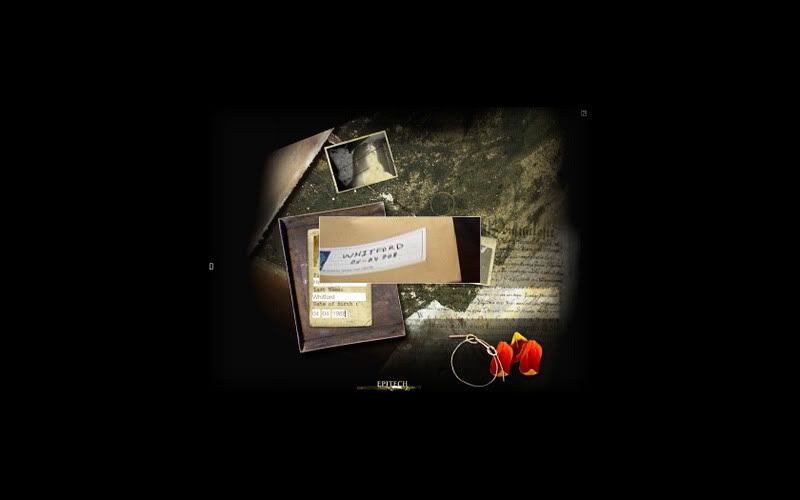 It's all very creepy, and it's an old game-- four years old, in fact. It relies heavily on websites and even email in order to tell its story, so it's a good test of whether a persistent ARG can work.
It doesn't.
There are really three reasons for this, first, a sequel called Evidence: The Last Ritual has already come out (and I have it, and it's in my "to be played" pile). So, for instance, a very early puzzle tells me the answer I need to continue is at http://www.xeniph.com/ which forwards you to http://www.xineph.com/31504052414/ which is a nifty little puzzle. If you solve it (which I did), you will not get an answer that will allow you to progress on the CD. In fact, that puzzle occurs nowhere in Missing at all, so I can only theorize that it's for Evidence. Yet some provision for players of Missing should have been made. I had to consult the one and only walkthrough on the web, which told me to go to http://www.xineph.com/aze229d which actually contains the first puzzle you must solve.
The second is the nature of search on the web. The game was designed to give you fairly esoteric terms to search and have the correct website pop up in the top five results. Apparently enough people have searched the esoteric terms (including some fairly obscure proper names) that websites who game either MSN or Google to increase their hitcount have latched onto them. So the first page will be full of garbage links and maybe somewhere on page two or three you'll find the page you need. In some cases the pages are totally gone from the search results, even though the websites still exist. This makes the game quite an exercise in internet sleuthing, and I quite enjoyed finding answers to puzzles in places where I wasn't supposed to go (again according to the walthrough).
The third is that you get email from a number of fictional characters. As part of the fiction, I was paired up with another purchaser of the CD. She was a grad student working on her thesis on the Salem witch trials. I tried to get chatty with her, since I've been to Salem many times, but my email to her just bounced. So much for realism. Later I was introduced to a hacker friend of hers, who threw together some little applets that helped with some of the puzzles. My hacker buddy was so 133t that my ISP's spam filter automatically blocked anything from his address. Not to mention that my own spam filter routinely thought all the emails from the various characters were spam, I had a couple of weeks of looking through my spam bucket for hints and clues.
So the game cannot be played without a walkthrough. The shelf-life of Missing is greater than your average ARG, but it's still finite.
The walkthrough is pretty great, with hints instead of outright solutions, then links to outright solutions. It's really one of the best of its type I've seen on the web, so I was amazed when I got to the end and found this:
Wow. Who goes through crafting such a complete and helpful walkthrough for a game they hate? It's just one of the many mysteries of Missing.
In closing, the greatest pleasure I received from this game was ending it. It was frustrating, for the most part, exceedingly monotonous, and the constant interruptions of having to check for clues online makes one feel annoyed throughout the entire game. The ending of the game leaves room for a sequel to In Memoriam; hopefully, however, that will never happen. The ending of this game, after all of the hard work the player goes through to see what happens at the end is inexcusable I feel. After all of the build-up and torment (playing this game), it is as if the developers hand you a a piece of garbage and say: "Here, this is for your efforts." The on-scene locations, via video clips, were nice to watch although each were very brief. The graphics were nice, and the story keeps the player interested enough to want to see what happens at the end. Aside from the aforementioned good points of the game, everything else is awful. I'd recommend reading through my walkthrough (e-mails, messages from the Phoenix, spoilers, etc) for an almost complete understanding of the game. Without playing the game, and merely reading this walkthrough, you will just miss out on the frustration and annoyances of the gameplay, and the several mini-videos throughout. Ultimately, you aren't missing much in my opinion.
He is right, the ending of Missing is a slap in the face. The last two puzzles aren't puzzles at all, they're twitch games. You have to first complete a Pac-man clone, then battle your way through a top down shooter. It was as though the author (and it is a single author) thought, "Gee, what's the hardest thing I can make an adventure gamer do? I know! I'll have them complete classic arcade games!"
SPOILERS AHEAD
Once you jump through those hoops, you have to play the killer himself in a strategy game that he's made. If you lose, a bomb will go off and kill the journalist and his girlfriend. Nice stakes, and it was a decent game, but after a couple of turns, your hacker friend breaks in and tells you that he's about to locate our heroes based on the signal from this game (or some such gobbledygook), and that you should keep the killer on the line as long as possible. Well, it's a turn based strategy game, so I took a really long time trying to decide my next move. Did the killer complain? Nope, he waited patiently. Of course, I could have left the darn thing sitting there all night if I wanted, because it was a set number of moves before the hacker broke in again and told me that he'd found them and that the police were on their way! Woot! End of game.
Really.
But see, I was kicking the killer's ass. I was going to win, and I never got the chance to best him.
Then a half hour later my friend the Italian detective sends an email (apparently texting from his phone) that he's at the place and it's dark and creepy. Then a couple of hours later I get an email that says they're safe, the a sometime after that I get an email with a link to a video of the girlfriend thanking me for saving her. The video is shitty, and where's the guy?
On the one hand, the way the game is set up dictates that this is how it must end, because suddenly we're not dealing with the carefully crafted puzzles of the killer, we're trying to get people out of a warehouse, and everybody doesn't have video cameras strapped to their night-vision goggles. When they get the victims back to the police station, they're not worried about the schmoe at the computer who helped find them, they just want a cup of coffee and a blanket. So there is a bit of verisimilitude in the anticlimactic ending. On the other hand, in a game that lived or died on it's presentation and style, this was just not cool in any way. I think they ran out of money.
END SPOILERS
And you'd think that after all this bitching it's clear that this is a bad game, but it's not. It's a great premise, it exudes style, the puzzles are great, I learned stuff about European landmarks, the sound design was amazing, the films told a great story, and the lead actress was incredibly hot.
I would do it all over again. And I will, in Evidence.
The best part? Two weeks after I finished the game, long after I stopped thinking about it, I got an email from the killer.
He's still out there.
It was all part of his plan.
And he knows who I am.
Thursday, April 19, 2007
On Context
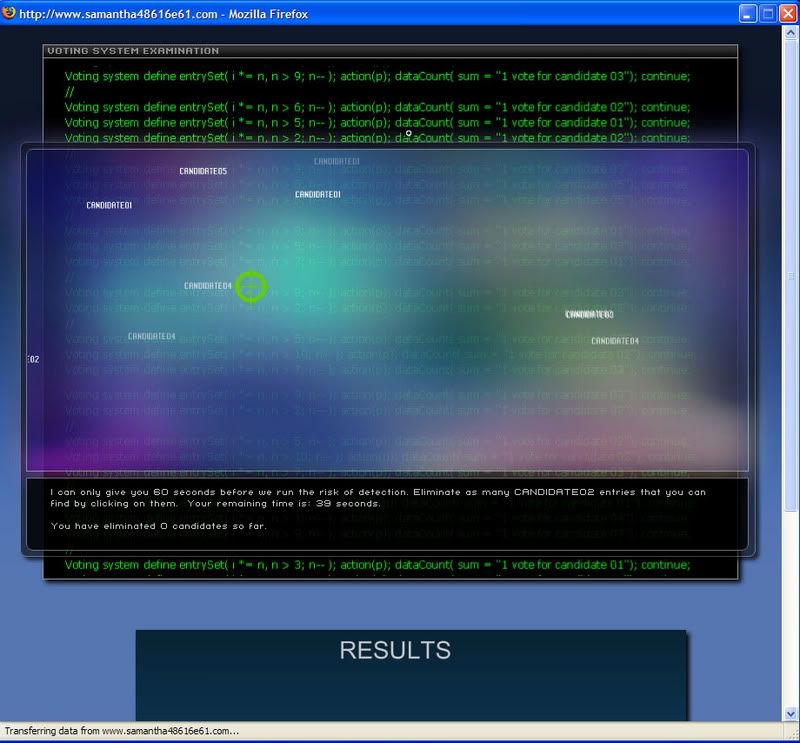
This is quite possibly the silliest game ever. It's a little flash game where the words "candidate01" through "candidate05" come floating out from the center. The player controls a crosshairs and must locate and click on as many candidate02's as he can in one minute. The best I've ever done is 24 zaps in the minute. One person online claims to have gotten over 100, but I think he's lying as I don't see how that's possible given the speed of the words and the number that pop out in a minute.
Reason dictates that I should play this for about five minutes and be done with it forever, yet I keep going back to it. Why? Because I want to prevent an election from being rigged.
You see, this little game is part of an alternate reality game surrounding the Heroes TV show. The show hasn't been on TV for over a month, but the internet has been alive with a conspiracy. One of the heroes is running for congress, and we've (that is, those of us dealing with the ARG) found out that the villain has rigged this election. Everytime we zap one of those candidate02's, we're getting rid of a fake vote. If everyone manages to zap enough (and we have no idea how many are enough) then we will change the outcome of the election.
So I click and click, and after every session, I enter my email so I'll get credit for the 20 or so votes that I've zapped. I want to change the world. I want to be a hero. In the larger context, zapping those votes means I can.
On the other hand, I worry. There's no proof that I'm actually getting rid of bad votes. I could be helping rig the election. I don't zap votes for "Petrelli," I zap "candidate02." Who is he? I don't know. So while I've been told that I'm fighting for the good guys, there are too many layers of abstraction for me to be sure.
This game is remarkably similar to one of the first videogames ever invented for the home TV. On Ralph Baer's brown box, you could set up a game where one player controlled a red box, and the other player controlled a white box. The white player chased the red player around (using early joysticks) and tried to catch him. The game was over when you got caught, then you would switch.
35 years later we're still playing the same game.
Subscribe to:
Posts (Atom)